Set your course. It holds it.
Steers a straight line through wind and current — compass, GPS, route and wind, for power and sail. Built for vessels 25 to 60 feet.
- 25–60 ft
- Power & sail
- NMEA 2000
Indicative prices in US dollars, excluding local taxes, duty, shipping and installation. Your Deeprey dealer quotes the final price for your territory and helm.
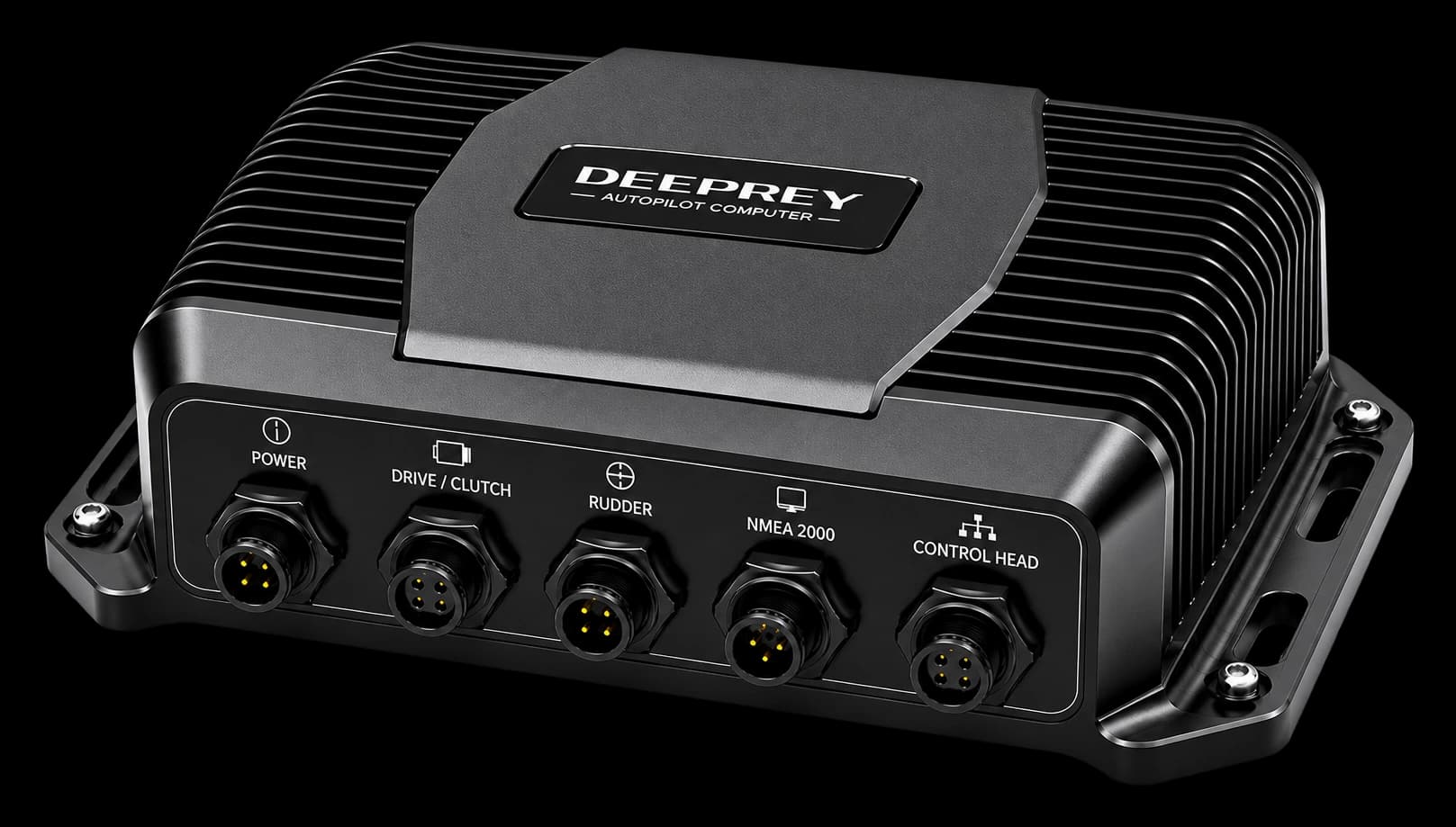
One box. Five connections.
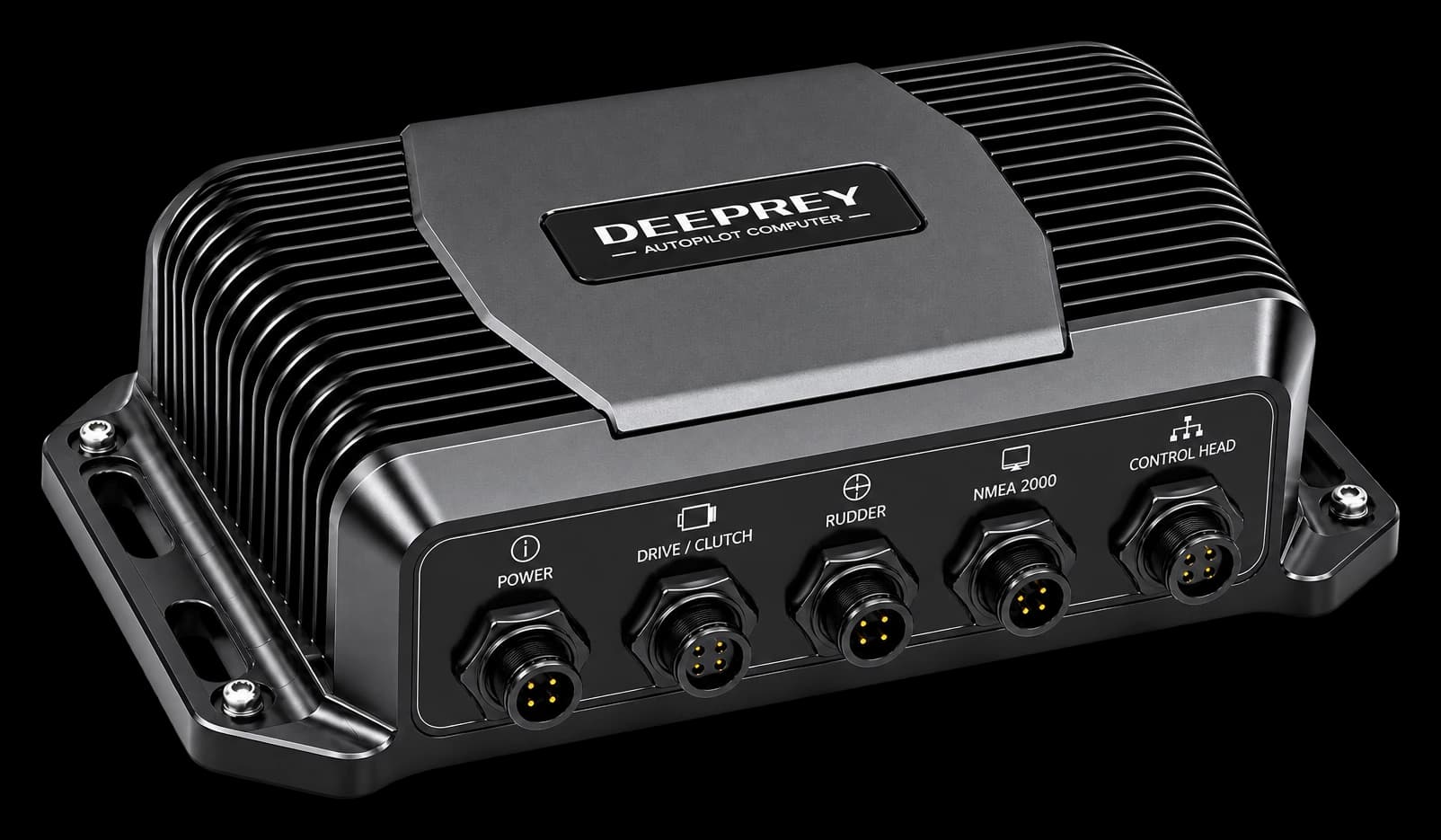
The autopilot computer is the whole system: it takes power, drives your steering, reads rudder angle, talks to the rest of the boat over one network cable and runs its own link to the helm keypad. Everything else — heading, GPS and wind — already lives on your NMEA 2000 bus.
- 01
Power
Straight off the 12–24 V vessel bus. Under a watt on standby, so it can stay live at the dock.
- 02
Drive / clutch
Drives the steering you already have — a reversing hydraulic pump or a mechanical drive — at 12 A continuous, 24 A peak. A clutch output frees the wheel on standby. No separate drive box.
- 03
Rudder
Reads rudder angle for precise holds. Optional and auto-detected: if it's not fitted, the pilot steers without it.
- 04
NMEA 2000
One NMEA 2000 cable brings in heading, GPS and wind and carries control from any Deeprey MFD.
- 05
Control head
A dedicated RS-485 link for the DPA-KP1 keypad, separate from the NMEA 2000 network. One cable carries power and control up to 50 m to the helm.
Sealed, deterministic, and built to drive real loads.
- Vessel size
- 25–60 ft (7.5–18 m)
- Steering systems
- Hydraulic · mechanical (cable / rack)
- Power supply
- 12–24 V DC
- Standby draw
- < 1 W
- Drive output
- 12 A continuous · 24 A peak
- Drive types
- Reversing pump · mechanical linear & rotary
- Clutch output
- 4 A, PWM (12 / 24 V selectable)
- Rudder feedback
- 0–5 V analog, optional (auto-detected)
- Control loop
- 10 Hz, 5-term PID
- Steering modes
- Compass · GPS · route · wind · tack
- Heading source
- NMEA 2000 (10–20 Hz)
- Control head
- DPA-KP1 keypad (RS-485), up to 4 units to 50 m
- Enclosure
- IP67 die-cast aluminium
- Networking
- NMEA 2000 · USB-C (service)
- Updates
- Dual-bank OTA, signed, auto-rollback
- Compliance
- Engineered to meet EN 60945, IEC 62065, NMEA 2000, FCC Part 15
- Sealed for the engine space
- IP67 die-cast aluminium enclosure, engineered to live in the bilge or lazarette, not just a dry locker.
- Deterministic control
- A 170 MHz real-time processor runs the steering loop at a fixed 10 Hz, boots in under half a second and draws under a watt on standby.
- Drives your steering directly
- A full H-bridge runs reversing hydraulic pumps and mechanical drives, with a clutch output to free the wheel — no separate drive box to wire in.
- Steers off the network
- Heading, rate of turn and heel read straight from NMEA 2000 — no proprietary heading sensor to buy or calibrate.
Steered from the screen you already have.
The pilot shares one NMEA 2000 bus with your Deeprey chartplotter. Engage it, change modes and follow a route from any Deeprey MFD — or wire in the DPA-KP1 keypad for a dedicated set of controls at the helm.
Fitting & support.
Wiring, drive sizing and cover for the life of the pilot.

13
Countries5
ContinentsInstalled by your local specialist.
Deeprey units are commissioned by marine electronics specialists across five continents — handling the mount, wiring, NMEA integration and first sea-trial calibration.